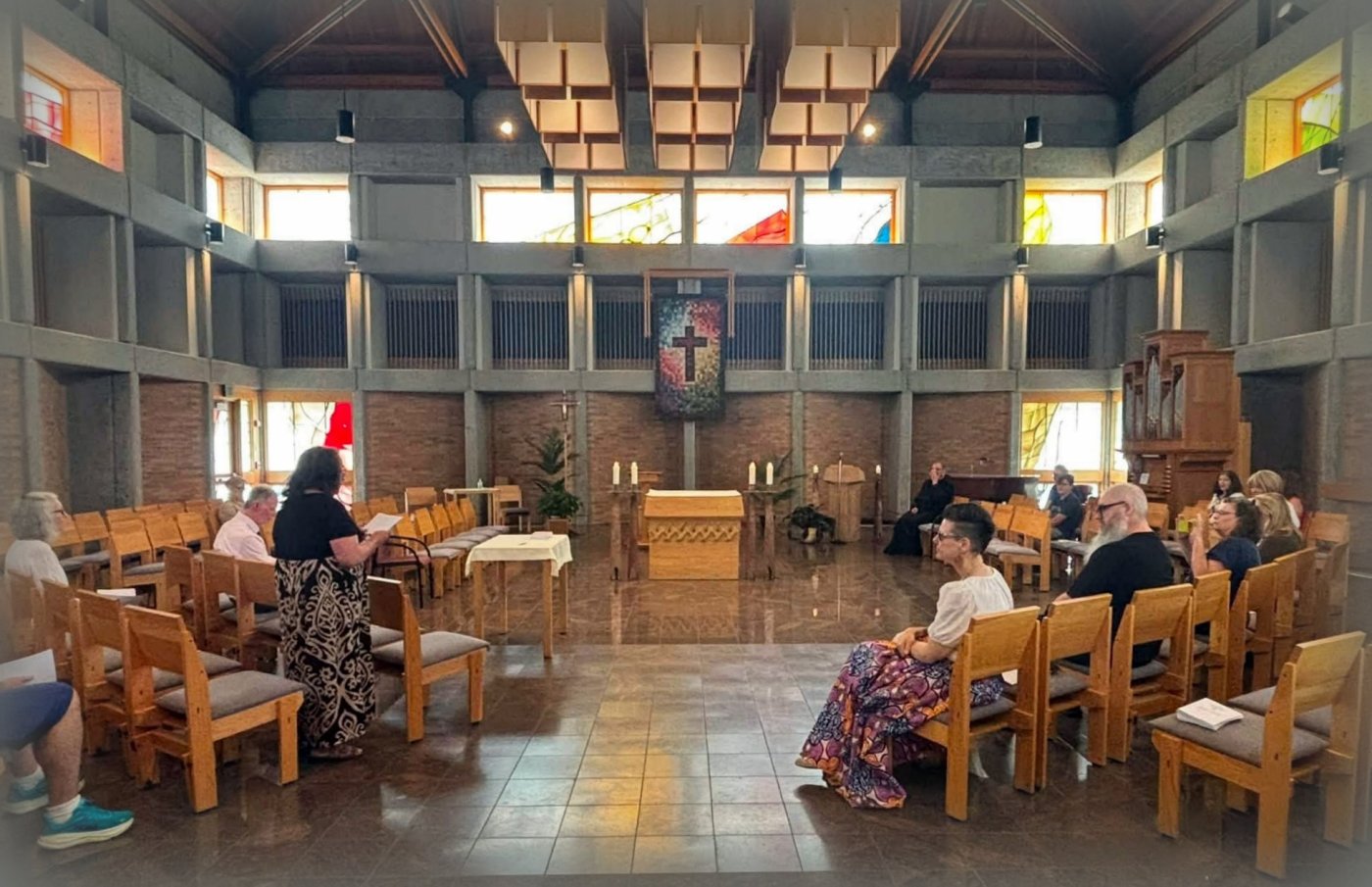
Being a Benedictine oblate is a way of life. Oblates desire to live as monks in the world, seeking God by recognizing the sacred in their everyday life, in their family, and in their workplace. Being part of a community of monks and oblates is a source of learning and support for our spiritual journey.
On the second Saturday of each month, the oblates of Christ the King Priory, the monastery I am an oblate of, gather to learn more about the Rule of St. Benedict. Our day includes morning prayer, monastery news, Lectio Divina, Mass, midday prayer, lunch, reading the Rule of St. Benedict, and small-group discussions of a selected book.
Prayer is the foundation of Benedictine spirituality. In August, we focused on Ways to Pray (Chapter 5) in the book Saint Benedict on the Freeway: A Rule of Life for the 21st Century by Corinne Ware. Benedict wrote in the Prologue of the Rule— “First of all, every time you begin a good work, you must pray to him most earnestly to bring it to perfection.” In the Apostle Paul’s letter to Thessalonica, he instructed the new church community to “Pray without ceasing.” (1 Thessalonians 5:17)
But what is prayer? And how is it possible to always be praying?
A friend recently asked me how I prayed, especially for others. So often we think that prayer means choosing the right words to speak to God, and that somehow, if we find those magic words, prayer might work “better”. We will get what we prayed for. Many believe that the purpose of prayer is to express what we desire—and that the right words might bring about the reality we hope for. But prayer is i much more than words or being attached to a specific, longed-for outcome.
The definition of prayer must be reimagined. There are many ways to pray, and it is possible to pray without ceasing. “Prayer is not so much our words to God as our life in God.” (Unknown author quoted by Caroline Myss) Reflecting on the chapter, I created a list of what prayer is:
- Prayer is way of being.
- Prayer is a way of seeing. “What if this way of seeing means that you believe one can continuously reference God as here?”
- Prayer is sense of being accompanied by God.
- Prayer is a lively awareness of God “If we define prayer as a lively awareness of God, not just words addressed to God, then cultivating this consciousness would be, as Paul says, to pray without ceasing.”
- Prayer is believing God is here; God is with me always.
- Prayer is listening and response.
- Prayer is remaining open.
- Prayer is more attitude than activity. “If prayer is maintaining openness to and contact with God, then it is more attitude than an activity.”
- Prayer is a relationship.
- Prayer is meeting with the truth–the truth of who we are and the truth of what is.
- Prayer is praise and lament. Prayer is expressing our desires, longings, fears, concerns, and so much more.
- Prayer is being with God.
- Prayer is freeing ourselves from attachments. “The more attached we are to outcomes and possessions, the less free and happy we are. Detachment, then, is caring less and less about events and ‘stuff ‘, and more and more about orienting toward God.”
Prayer can include words, of course, in practices like Lectio Divina, journaling, writing prayers, praying the Psalms, and extemporaneous prayers, but praying with our body or images can be ways to connect with the Divine as well.
Visio Divina is a practice of praying with images. One can simply “be still” with, beholding an image, artwork, or a collage (or creating one), and listen to what God brings to the mind, body, and spirit —perhaps using prompts to write a poem or to journal. I shared this practice to introduce our small group discussion.
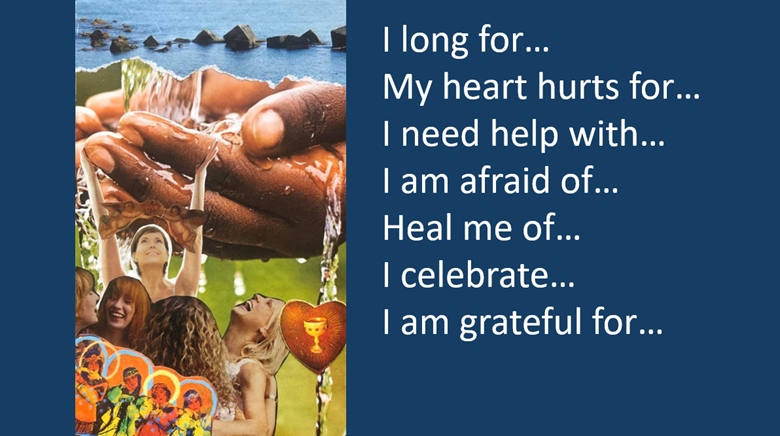
Consider trying this practice as well—sit with the collage image for several minutes. Listen to what God may be saying to you through the hands, the water, the people, the expressions, and the symbols. Journal what bubbles up and/or respond to the prompts. Your longing, pain, fears, needs, and gratitude are part of you. Bringing all of who you are to prayer is being in full relationship. Review the definitions of prayer—allow yourself to feel God’s presence.
God provides uniquely what each of us need, as the varied responses from our oblates after this prayer practice suggest. One person had an image of God pouring blessings from a pitcher over the big blue marble of this earth, that includes each of us. Other responses included expressions of gratitude, resting in God’s presence, celebrating that “I am loved”, a sense of abundance, a fear of scarcity, a longing for more joy, remembering to receive blessings and to be grateful. Expressing our longing is prayer, and sharing in community is a powerful way to pray for and remember each other.
In small groups, we all discussed the following questions. Feel free to share your responses in the comments!
1. Which prayer practice is most comfortable for you? Which prayer practice is most out of your comfort zone? Is there a prayer practice you would be open to trying?
2. What is your definition of “prayer”? Which descriptions resonate with you and why? “a lively awareness of God”, “attentiveness to God’s disclosure”, “maintaining openness to and contact with God”, “more an attitude than an activity”, “a relationship”, “freeing ourselves from attachments.”
3. Is there a word, phrase, rhythmic prayer or mantra you use to bring you back to the awareness of God? In what situations do you use it?
4. “The desire for prayer is the desire for a meeting with truth.” How have you experienced this in your prayer life (examples in the book come from journaling prayer).
5. What was your experience with the prayer practice this afternoon?
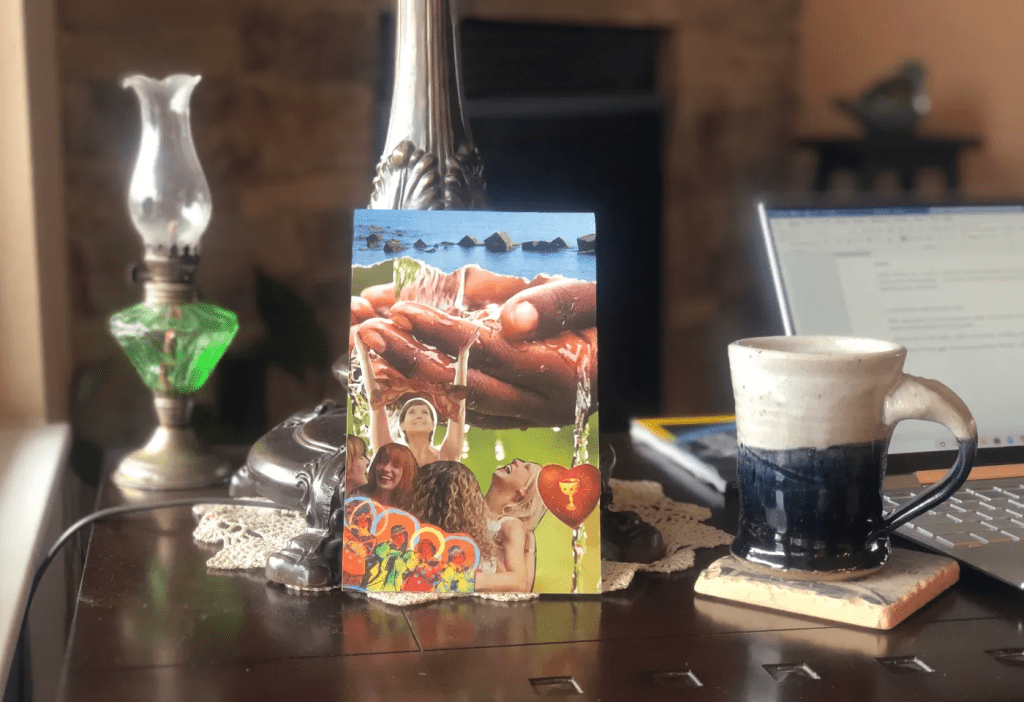
I shared about the SoulCollage card used in our prayer practice in a previous reflection: Holy Water: Image of Gratitude.
© Jodi Blazek Gehr, Being Benedictine Blogger


Leave a comment